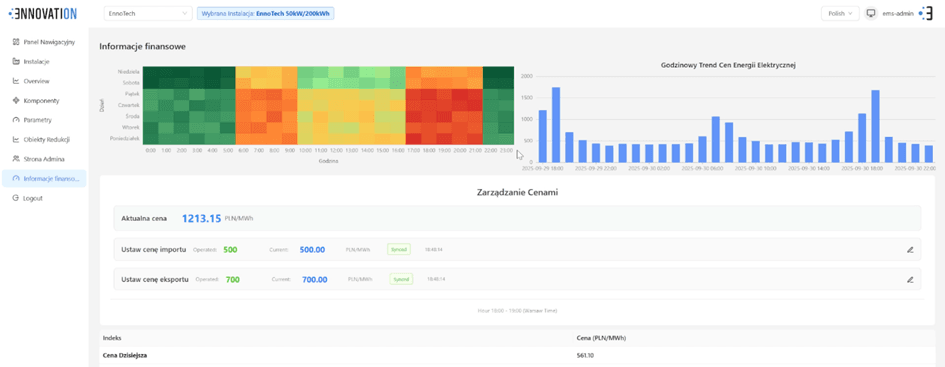
Interface view:


ENNO-EMS is intelligent energy management software that helps reduce costs, increase efficiency and generate revenue from energy storage systems.
The system monitors, controls and optimizes energy flows in an enterprise. It helps reduce the cost of energy drawn from the grid, increase the use of renewable energy and energy storage, and prepare the company for new revenue models.
ENNO-EMS works as a central energy management system, connecting key infrastructure elements into one integrated ecosystem.
ENNO-EMS integrates energy storage systems, PV installations, EV chargers, renewable energy sources, heat pumps, gas power plants, thermal energy storage and other elements of energy infrastructure.
The system automatically selects how the energy infrastructure should operate based on the facility’s needs, energy prices, weather conditions and operator requirements.
Excess generated energy is not exported to the grid. The system charges the energy storage system, starts devices or limits production when necessary.
Benefits: the possibility of installing a larger PV system, better use of self-generated energy and full compliance with grid connection conditions.
The system follows planned charging, discharging and power-source selection cycles according to the facility’s operating schedule.
Benefits: maximum use of local energy, adjustment of consumed power to the contracted capacity and DSO requirements, and avoidance of excess-demand charges.
The algorithms take into account energy prices, weather forecasts, and current and planned demand.
Benefits: real savings, higher operational efficiency and lower grid load.
Enables the energy system to operate completely independently from the external grid, ensuring power continuity and protection in emergency situations.
Benefits: independence from the power grid, reliable power supply, high reliability and the ability to power critical loads.
This function flattens the consumption profile by eliminating short-term high power demand. The system manages energy flow from the storage system or PV to balance the consumption profile at the point of connection.
Benefits: lower bills, more predictable consumption and higher energy efficiency.
This function evenly distributes load throughout the day so that energy consumption at the point of connection remains stable.
Benefits: lower bills, reduced distribution charges and avoidance of grid overloads.
The system enables the energy storage system to charge when energy prices are low and use or sell energy when prices are high.
Benefits: the possibility of generating revenue from energy sales and optimizing energy costs.
In the event of a grid power outage, the energy storage system takes over the power supply function. The system maintains the minimum required energy reserve.
Benefits: avoidance of power interruptions and stable business operation.
The energy storage system dynamically compensates reactive power based on measurements at the point of connection, preventing the infrastructure from generating reactive power.
Benefits: avoidance of penalties and charges related to generated reactive power.
Energy storage systems with static transfer switches can provide switching times as low as 4 ms, performing the UPS function.
Benefits: a solution for critical infrastructure, hospitals, strategic facilities and public buildings. ENNO-EMS also enables PV systems and generators to be combined with automatic transfer switch systems.
Increasing or decreasing grid power is proportional to the grid frequency. The purpose of the storage system is to maintain the correct frequency.
Benefits: proper operation of powered devices and operational stability of the enterprise.
The energy storage system helps stabilize grid voltage by storing energy when voltage is too high and supplying it when voltage is too low.
Benefits: stable voltage, more efficient use of PV energy and protection of electrical devices.
Sample views of the system and energy management topology.

ENNO-EMS provides full control over energy, automates processes, increases safety and supports cost optimization.
Thanks to the monitoring and data analysis features in ENNO-EMS, the user gains full insight into the operation of their energy installation — both in real time and historically. The system collects data from key devices, such as batteries, inverters and meters, and then presents it clearly, enabling both ongoing and long-term decision-making.
This enables:
Through ENNO-EMS software, the user gains access to forecasts of energy production, revenue and savings. The system analyzes historical data, current consumption and market prices, and then estimates the profitability of operating the PV installation and energy storage system.
This enables:
ENNO-EMS is a system that groups various energy generation and consumption units, as well as energy storage owners and locations, managing them as one entity to optimize costs, increase energy efficiency and facilitate their participation in the energy market.
Benefits of energy aggregation:
ENNO-EMS increases the facility’s resilience to power outages by automatically responding to severe weather warnings. The system tracks weather alerts and, in the event of risk, starts charging the energy storage system in advance.
This enables:
Thanks to integration with external data sources, the EMS enriches its operation with up-to-date energy market information and technical data from external systems. The system collects, among other things, energy prices from the Polish Power Exchange (TGE), demand and renewable energy production forecasts, and SCADA system data, allowing the energy management strategy to be precisely adapted to changing conditions. ENNO-EMS also communicates with telemechanics systems, continuously monitoring and exchanging information with the distribution system operator.
This enables:
Thanks to its safety module, ENNO-EMS not only manages energy, but also actively monitors the technical condition of the installation. The system analyzes battery health (SOH), state of charge (SOC), and continuously detects overloads, failures and other irregularities.
This enables:
The ENNO-EMS system meets cybersecurity requirements, including requirements for connection to critical infrastructure.
The devices meet the requirements of the following standards:
The solutions are also compliant with:
Support for the virtual prosumer makes it possible to use renewable energy without owning a PV installation. For example, a user in Gdańsk can benefit from renewable energy generated in Warsaw. The energy is settled on the electricity bill, while the recipient gains savings and participates in the energy transition — without the need to install equipment on their own building.
The ENNO-EMS system enables comprehensive energy analysis and full reporting, supporting business owners and installation operators in making informed business decisions. With access to real-time data and parameter archiving, users can control system performance and plan optimization activities.
The system offers, among other things:
The ENNO-EMS system enables automatic and remote control of energy processes, so companies and installation operators do not have to worry about infrastructure management. The algorithm handles it automatically while reducing costs.
The system offers, among other things:
The ENNO-EMS system supports comprehensive management of electric vehicle charging infrastructure (EV).
The system offers, among other things:
The ENNO-EMS system provides intelligent energy management that enables users to maximize savings and performance through automated decisions based on data and forecasts.
The system offers, among other things:
Choose a package matched to the scale of your installation, the required level of automation and the scope of energy management.
A package for basic monitoring and daily control of the energy system.
A package for companies that want to optimize energy use and automate system operation.
A package for advanced energy management, revenue models and integration with wider infrastructure.
ENNO-EMS materials, price list and formal documents required for registration and use of the application.
Download the main ENNO-EMS system description with information about its features, applications and integration capabilities.
Tell us about your project and we will recommend the best solution for your needs.
Who is the developer of the energy storage management software (EMS) used in Ennovation Technology’s energy storage systems?
The software is owned by Ennovation Technology, which gives us the flexibility to integrate with any devices and adapt energy storage control to the specific infrastructure and energy consumption profile. This flexibility usually gives us a competitive advantage, enabling the client to implement optimal energy usage strategies.
Does the EMS system include weather or market price prediction?
Yes, Ennovation Technology’s EMS system includes a predictive module that collects weather data. However, to the best of our knowledge, the current prediction error is about 20%. Our team is actively working to minimize inaccurate predictions.
Is the EMS system connected to the Polish Power Exchange (TGE)?
Yes, our system is integrated with the Polish Power Exchange (TGE) and other European energy exchanges. This allows dynamic data acquisition on electricity prices, which is used for intelligent charge and discharge management — optimizing both costs and efficiency.
Can the EMS system work with other generation devices like gas generators, electrolyzers, PV installations, CHP units, diesel generators, and biogas plants?
Yes, our EMS (Energy Management System) can integrate with gas generators and any other generation devices. Communication is handled through analog signals or digital communication protocols such as Modbus, CAN, or any other required protocol.
Is the EMS system suitable for both small and large-scale installations?
Yes. The EMS system is fully scalable — it can manage both single units and complex, redundant systems. Its flexible architecture allows easy adaptation to current needs and future infrastructure growth.
Does the EMS system use artificial intelligence and algorithms that adapt to changing conditions?
Yes. EMS uses intelligent algorithms that automatically optimize its operation in real time. This allows the system to respond to changes in consumption, production, and energy prices — increasing energy efficiency without requiring manual intervention.
What if the ENNO-EMS software is too complex? Do I need technical or programming knowledge to use it?
No programming knowledge is required. Users can adjust settings to their needs without advanced technical expertise. Additionally, we support our clients throughout the entire process and can tailor the interface and reports to the company’s specific requirements.
Is ENNO-EMS installed locally or cloud-based?
ENNO-EMS is a cloud-based or hybrid solution. This means the system operates remotely via the cloud, but historical data can also be stored locally on the client’s disk. The amount and duration of local data storage can be configured individually.
Does ENNO-EMS meet cybersecurity requirements for critical infrastructure?
Yes, ENNO-EMS meets cybersecurity requirements and can be connected to critical infrastructure. The system complies with the following standards: IEC62351, NERC CIP, EU NIS2 Directive, ISO/IEC 27001.
Is ENNO-EMS suitable for managing an energy cluster or cooperative with multiple locations?
Yes. The system enables management of distributed infrastructure, such as city-wide PV installations, with features like local balancing. It’s also suitable for energy cooperatives and clusters.
Is ENNO-EMS limited to one location, or can it manage devices across multiple sites? How does this work in practice?
The system supports distributed infrastructure management. For example, in an energy cluster or cooperative, you might have: Location 1: Industrial facility; Location 2: Charging stations; Location 3: Energy storage; Location 4: Biogas plant; Location 5: Water utility company with PV installation.
Each location is equipped with an EMS controller, energy measurement device, and communication interface with local energy sources. These devices send data to a central server, where calculations are performed to balance energy flows. Based on these calculations, energy flow in the storage system is determined. The entire cluster or cooperative is then visible in our EMS system as one integrated infrastructure, with access to data from each site.
Energy cooperatives and clusters often require energy flow accounting. Our solution allows analysis of energy consumption, production, and grid exchanges.
Can the EMS system be integrated with different devices and systems?
Yes. The system supports many common communication protocols such as CAN, MODBUS, DNP 3.0, and MQTT. This ensures easy and flexible integration with various energy infrastructure components. In addition, the EMS system fully integrates with SCADA systems, enabling seamless cooperation between different management systems.
Does the EMS system support dynamic tariffs and accounting with DSOs?
Yes, the EMS system fully supports dynamic tariff management and integration with Distribution System Operator (DSO) billing systems. This enables real-time energy consumption optimization and automatic adjustment to changing rates and contractual terms.
What is the estimated cost of the ENNO-EMS solution?
The pricing for the service and software is available on the EMS product page. For inquiries, please contact: ems@ennovationtech.eu