

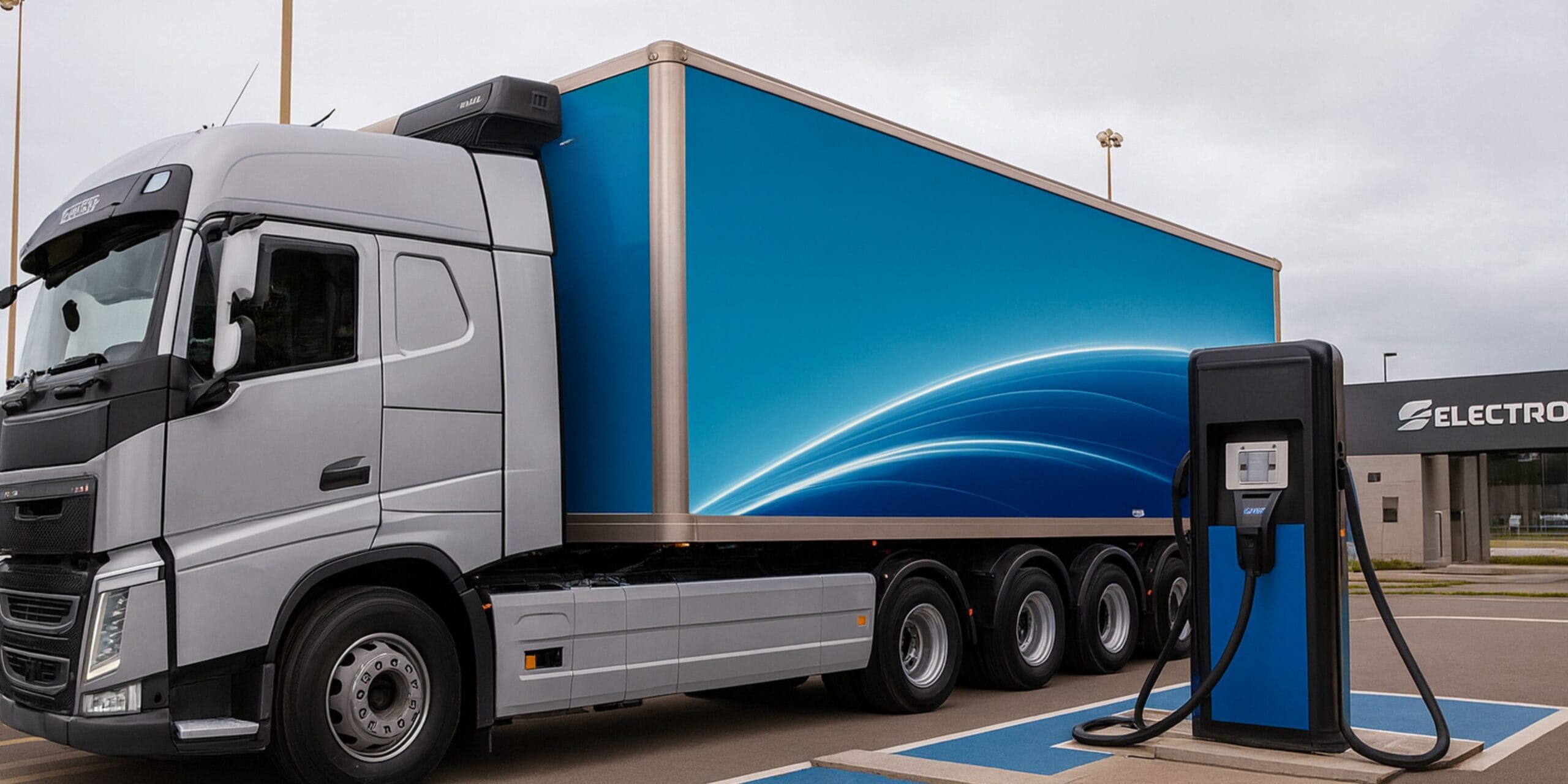
The development of megawatt charging technology for electric vehicles marks another step toward the decarbonization of heavy transport. The latest solutions, such as the Ennocharge 700 kW – which can also be equipped with a megawatt charging socket of the MCS (Megawatt Charging System) type – radically shorten the charging time for trucks, enabling efficient fleet electrification. Despite its many advantages, megawatt charging comes with challenges such as high upfront costs and infrastructure requirements, which remain a significant barrier to faster adoption of this technology.
Characteristics of Megawatt Charging Systems
Megawatt Charging Systems (MCS) represent the most advanced technology in powering electric heavy-duty vehicles. These systems are designed specifically for the large batteries of trucks and other heavy vehicles, enabling charging at unprecedented power levels.
The first commercial solutions are already appearing on the market, such as the SAT 1500 MCS from Ekoenergetyka, which offers 1500 A. This innovative device uses a specially designed MCS plug. By comparison, traditional fast DC chargers rarely exceed 500 A.

MCS Connector
In March 2024, during a demonstration in Munich, the capabilities of megawatt technology were showcased by charging an electric truck at more than 700 kW with 1000 A. These impressive parameters mean that in practice, a vehicle can “refuel” enough energy for hundreds of kilometers of driving in just tens of minutes.
For comparison:
A typical home EV charger has about 11 kW of power – it would need more than 60 times longer to deliver the same amount of energy.
A standard household fuse cuts off at around 16 A. Here we’re talking about currents over 60 times stronger than those powering an average apartment.
To estimate how long it takes to fully charge an electric truck, e.g., a concrete mixer with a 500 kW electric motor and a total battery capacity of 387 kWh, here’s a comparison for three types of chargers:
| Charger Type | Max Power | Full Charging Time for 387 kWh |
| Kempower Mega Satellite | 1,200 kW | ~19 minutes |
| Ennocharge 700 kW by Ennovation | 700 kW | ~33 minutes |
| 180 kW Charger | 180 kW | ~2 hours 9 minutes |
From CCS to MCS: Evolution of Charging Infrastructure
For the past years, CCS (Combined Charging System) has been the dominant fast DC charging standard for electric vehicles – both passenger and light commercial. With power delivery of up to 350 kW, CCS provided adequate infrastructure during the crucial growth phase of electromobility. However, as heavy trucks enter the scene, CCS is hitting its limits – particularly in charging time and power. To meet these needs, MCS was developed.
A key feature of MCS is its compatibility with the existing CCS system. Although the two standards differ in connector design and technical parameters, trucks can be equipped with two ports – one MCS for ultra-fast charging on the road, and one CCS for charging at depots or during lower grid load. This hybrid approach allows fleet operators to manage energy flexibly, adjusting charging strategies to real needs and conditions.
Truck manufacturers are already including MCS in their development plans. Mercedes eActros, Volvo Trucks, and Scania all declare readiness to integrate MCS as a standard. Their vehicles will be able to use both new megawatt infrastructure and existing CCS chargers, which will accelerate adoption and ease the transition to electric power.
At Ennovation Technology, we also pride ourselves on innovation in this area. Our Ennocharge 700 kW charger, with minor modifications, can be equipped with such a socket.
Challenges and Barriers to Megawatt Charger Deployment
| Category | Advantages | Disadvantages & Challenges |
| Operational Efficiency | Brings electric truck performance closer to diesel and reduces charging time to just minutes. | – |
| Business Benefits (stations) | Higher customer turnover, better use of space, higher ROI. | High purchase and installation costs of components. |
| Energy Infrastructure | Can integrate with energy storage to buffer peak demand. | High grid requirements – very high connection capacity needed. |
| Scalability | Potential to build charging hubs for long-distance transport. | Limited availability due to investment and technological barriers. |
| Renewable Energy (RES) | MCS can integrate with solar farms, wind farms, and storage systems. | – |
| Practicality | – | Limited availability due to investment/tech barriers. Much more complex engineering. |
| High Copper Content | – | Large amounts of copper are needed in cables and connectors for conductivity and safety. Leads to high costs and theft risk. |
MCS and Green Energy Support
As heavy-duty electromobility develops, charging is only one part of a wider ecosystem. The future belongs to next-generation charging hubs – locations that not only offer ultra-fast MCS infrastructure but also integrate renewable energy and provide full support facilities for drivers and fleet operators.
One trend is combining MCS with local renewable sources such as solar panels, wind turbines, and storage. MCS is designed for such integration – both technically and functionally. This reduces grid load, increases hub energy self-sufficiency, and delivers real CO₂ reduction. Solar farms can supply energy during the day, while storage buffers it for peak hours or night use, stabilizing the charging system and lowering operating costs.
This is why comprehensive solutions are so important – combining ultra-fast charging hubs with energy storage, EMS (Energy Management Systems), RES integration, and V2G (vehicle-to-grid) technology for trucks. This approach, offered by Ennovation among others, enables the creation of self-sufficient, scalable charging centers that support the grid, reduce costs, and genuinely contribute to the energy transition in transport.
Contact:
Agnieszka Solarz
+48 691 104 591
a.solarz@ennovationtech.eu
Development Trends for Chargers in Poland
The future of megawatt charging systems in Poland requires deep modernization of the existing energy infrastructure, which is currently not adapted to handle loads of 1–3 MW per single connection. Despite record investments in distribution networks (PLN 9.2 billion in 2022), there is a lack of solutions enabling integration of hubs with such power, especially along TEN-T corridors, where charging infrastructure coverage for electric trucks is 0%.
Grid Challenges
Frequent power supply interruptions regulated by distribution system operators (DSOs) pose an additional risk to charging stability. Megawatt hubs require 10–20 MW connections (equivalent to a small town).
Need for Transformation
Current motorway connections do not meet e-mobility requirements. Building medium-voltage lines requires costly and time-consuming procedures. Solutions are needed that combine RES with storage and backup generation to reduce dependence on the central grid.
Regulatory Perspective
The AFIR directive obliges Poland to increase charging power sixfold by 2030. Meeting this target requires reforms in connection procedures and better coordination between NFOŚiGW, GDDKiA, and grid operators. Without this, development will be limited to pilots.
Key Takeaways
- Megawatt charging technology is already commercially available – e.g., Kempower Mega Satellite with up to 1.2 MW charging power.
- The main advantage of megawatt chargers is drastically reduced charging time for heavy vehicles, optimizing transport operations.
- High upfront costs and energy infrastructure requirements are significant barriers to development.
- Poland is not yet ready for large-scale deployment of MCS – the current grid does not meet MCS requirements, and the lack of high-power connections and low availability of truck charging hubs is a major obstacle.
- Integrating energy storage systems with charging infrastructure may be key to effectively implementing megawatt charging systems.
Megawatt charging systems can significantly accelerate electromobility in heavy transport, offering a real alternative to combustion engines. At present, Poland lacks the infrastructure to enable wide-scale deployment – particularly along TEN-T corridors, where truck charger coverage is 0%. Nevertheless, including these technologies in long-term investment plans and integrating them with RES and storage could, over time, provide a solid foundation for their growth.
Sources:
- https://korsokolbuszowskie.pl/wiadomosci/zacznie-sie-juz-jutro-brak-pradu-w-marcu-2025-w-calym-wojewodztwie-podkarpackim/s8MiHDY5JY8PkbvYZwKO
- https://www.pse.pl/dane-systemowe/praca-kse/czas-trwania-przerw-w-dostarczaniu-energii-elektrycznej
- https://korsokolbuszowskie.pl/wiadomosci/zacznie-sie-juz-jutro-masa-nowych-wylaczen-pradu-w-marcu-2025-w-wojewodztwie-podkarpackim/GPwM7dHxfdw8TWYAJhSX
- https://www.miasto.zgierz.pl/pl/content/planowane-wylaczenia-pradu-kwiecien-2024-r
- https://new.abb.com/news/detail/113917/abb-e-mobility-and-man-demonstrate-megawatt-charging-on-the-etruck-for-the-first-time?
- https://www.tauron.pl/dla-firm/ceny-maksymalne/pomoc
- Dodatkowe: https://www.pse.pl/home
- https://www.freightwaves.com/news/mercedes-benz-trucks-eactros-600-foreshadows-next-freightliner-ecascadia?utm_source=chatgpt.com
- https://www.emobility-engineering.com/scania-completes-first-charging-test-with-pilot-megawatt-charging-system-from-abb-e-mobility/?utm_source=chatgpt.com
- https://www.volvotrucks.vn/en-vn/news/insights/articles/2024/jun/the-expansion-of-electric-truck-charging-infrastructure.html?utm_source=chatgpt.com
- https://www.nrel.gov/news/features/2025/the-dawn-of-electric-trucking-calls-for-high-power-charging.html?utm_source=chatgpt.com
- https://www.tauron.pl/dla-firm/ceny-maksymalne/pomoc
- https://motoryzacja.interia.pl/auta-elektryczne/news-tak-szybko-jeszcze-nie-bylo-oto-najmocniejsza-ladowarka-na-s%2CnId%2C7413535?