

Ennovation is a partner in the HySPARK hydrogen project, which focuses on developing a comprehensive hydrogen ecosystem. One of the project’s objectives is to produce, within the emerging hydrogen valley, up to 5,000 tons of low-emission hydrogen annually. Moreover, the project plans to conduct tests of vehicles powered by this very hydrogen. The raw material will be produced and supplied by ORLEN S.A., while Ennovation will be responsible for providing hydrogen-powered vehicles.
The Role of Ennovation in the HySPARK Project
As part of its tasks in the HySPARK project, Ennovation is carrying out construction work on the Ennovum H670 hydrogen tractor unit, designed for long-haul transport over distances exceeding 500 km.
The Ennovum H670 model is a hydrogen-powered tractor unit in the classic 4×2 axle configuration, corresponding to the most commonly used setup in road transport.
With a wheelbase of 3,900 mm, the design allows for the efficient placement of all drive components, while maintaining full compatibility with a wide range of standard trailers.
In subsequent stages, the project plans to obtain ADR certification, which will enable the vehicle to be used for transporting hydrogen in trailers (MEGC – Multiple-Element Gas Containers), commonly referred to as compressed hydrogen trailers.
According to the schedule, by 2027 Ennovation will deliver four hydrogen-powered tractor units.
How does the conversion of a combustion vehicle to hydrogen work?
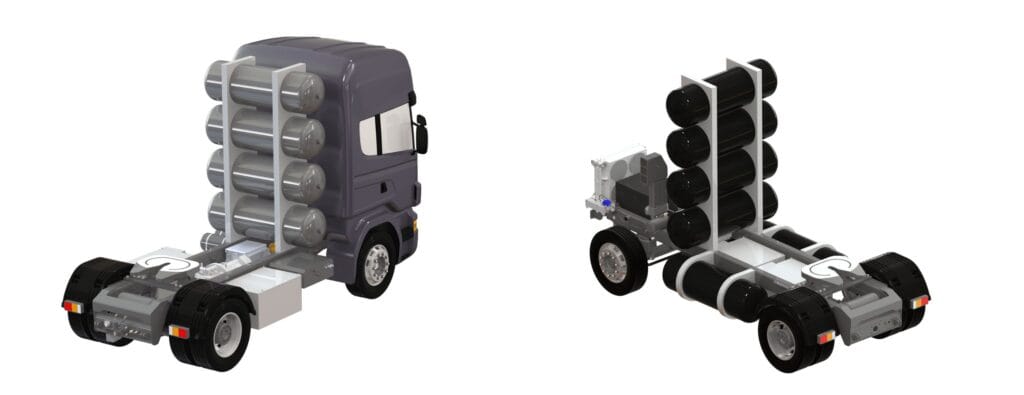
First, a MAN chassis will be delivered to Ennovation, which will be stripped of its combustion engine, gearbox, and fuel and exhaust systems.
The choice of a MAN vehicle stems from Ennovation’s previous experience in converting a concrete mixer from combustion to electric.
In the next step, the engineering team will begin design work, focusing on the placement of hydrogen drive components and the development of dedicated mounts and adapters. All components will be installed mechanically in a plug-and-play formula, without modifying their structure, and on the electrical side they will be integrated with the vehicle’s systems.
Example components used in the HySPARK project
- Fuel cell module
The key element of the vehicle’s drive system is the hydrogen-powered fuel cell module, with a nominal power of 85 kW and a maximum efficiency of up to 56%. The drive system for hydrogen tractors may consist of one or two such modules. Additionally, PEM (Proton Exchange Membrane) fuel cells are used, working in conjunction with a comprehensive BOP (Balance of Plant) system – responsible for supplying hydrogen and purified air to the cells. - Compressed hydrogen storage system
Compressed hydrogen flows into the fuel cell module from the storage system, which consists of four type IV tanks. Each has an inner layer made of HDPE (High Density Polyethylene), surrounded by a composite wrap reinforced with carbon fiber. This design ensures high strength while minimizing weight. The nominal working pressure of the compressed hydrogen storage system is 700 bar, which enables efficient hydrogen storage in the vehicle. - Battery system
The Ennovum H670 is equipped with a proprietary battery system that serves several key functions: it stabilizes the operation of the fuel cells, supports the drive system during periods of increased power demand, and enables energy recovery during braking, which translates into higher overall efficiency of the vehicle.
For those interested, the link below provides the full list of components.
Discover all components
The Importance of the HySPARK Project
In an era of ambitious EU goals for climate neutrality, hydrogen technologies may gain in importance. That is why our participation in the project is of great significance to us.
Let us recall that as part of the initiative, Ennovation is responsible for delivering tractors powered by low-emission hydrogen, which will be used, among other things, to transport hydrogen from ORLEN S.A.’s production HUB in Włocławek to hydrogen refueling stations (HRS) at Chopin Airport in Warsaw, planned for construction in the coming years.
Importantly, Ennovation, in cooperation with ORLEN S.A., IEN-PIB, ARTHUR BUS, ATENA, and the other nine consortium members, will help create a scalable energy transition ecosystem. This ecosystem has the potential to reduce CO₂ emissions in land transport and aviation and aligns with the EU’s plan for the development of hydrogen-ready airports by 2050.
Summary: HySPARK – A New Impulse for Mazovia and Europe
The HySPARK project is the result of close cooperation between 15 partners from 4 countries – including leaders from the research, transport, and technology sectors. Its main goal is to create a modern hydrogen ecosystem, where hydrogen will power trucks, public transport, and airport equipment at Chopin Airport in Warsaw.
We are excited to take part in the project and grateful for the trust placed in us, because as a company operating in electromobility, we know that the success of the energy transition depends on real-world implementations. With the support of, among others, the European Commission, ORLEN S.A., the City of Warsaw, and airports from Poland, Italy, and Ireland, HySPARK has the chance to become a model of a modern hydrogen valley and a benchmark for other European countries in implementing hydrogen utilization initiatives.
The amount of funding granted to the consortium: EUR 8,999,074.63.
Learn more about the HySPARK project
Consortium Partners:
ORLEN S.A.
The Institute of Power Engineering — National Research Institute
Warsaw University of Technology
LS Airport Services S.A.
BUREAU VERITAS POLSKA Sp. z o.o.
ARTHUR BUS Sp. z o.o.
CITY OF WARSAW
MIEJSKIE ZAKLADY AUTOBUSOWE Sp. z o.o.
RINA CONSULTING SPA
RINA TECH UK LTD
ATENA SCARL – DISTRETTO ALTATECNOLOGIA ENERGIA AMBIENTE
SEA, Milan Airports
In Climate Foundation
Galway airport